
- اتصل بنا : +86-15060765919
- راسلنا : bella@fespower.cn
⚡ Why Is Fast EV Charging Creating Pressure On The Power Grid?
As EV adoption accelerates worldwide, ultra-fast charging stations are expanding rapidly across highways, cities, logistics hubs, and commercial fleets. But behind this growth, one major challenge is becoming impossible to ignore:
Power grid capacity.
According to the International Energy Agency (IEA), global public charging infrastructure must grow nearly 9 times by 2035 to support rising EV demand. At the same time, charging power is also increasing dramatically — from 60kW and 120kW systems to today’s 480kW, 600kW, and even megawatt-level charging solutions.
🔋 Why Can’t Traditional Grids Handle Ultra-Fast Charging Alone?
A single 600kW fast charger can consume as much electricity as dozens of homes simultaneously. For fleet depots or charging hubs with multiple chargers operating together, peak demand can quickly exceed local grid capacity.
Research from McKinsey & Company
estimates that grid connection upgrades can account for up to 30%-40% of total charging station deployment costs in high-power charging projects.
This is exactly why battery energy storage systems (BESS) are becoming essential.
⚙️ How Does Battery Storage Actually Improve EV Charging?
Battery storage acts as an intelligent energy buffer between the grid and charging equipment.
Instead of drawing massive power spikes directly from the grid, the system can:
🔋 Store electricity during off-peak hours
⚡ Release energy during high charging demand
📉 Reduce peak grid pressure
💰 Lower electricity costs through peak shaving
☀️ Integrate with solar energy systems
🔄 Improve charging stability and uptime
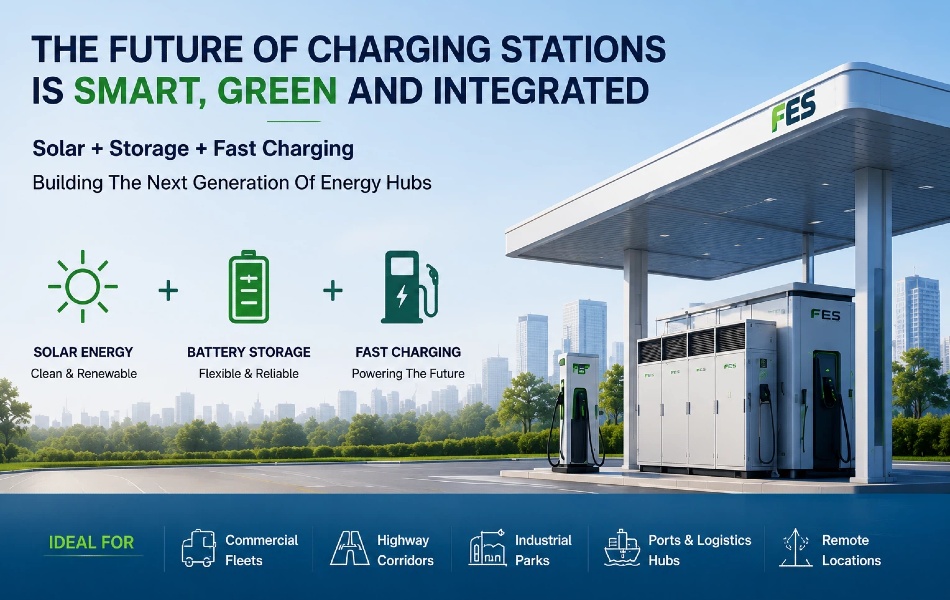
This architecture is rapidly becoming the preferred model for modern charging infrastructure.
📊 What Do Industry Data And Market Trends Show?
According to BloombergNEF, global battery energy storage deployment is expected to grow more than 20-fold by 2030.
Meanwhile, many charging operators are shifting their focus from simply installing chargers to optimizing energy management.
Recent surveys across Europe and Asia indicate that charging station operators are increasingly prioritizing:
✅ Grid stability
✅ Energy efficiency
✅ Peak demand reduction
✅ Renewable energy integration
✅ Long-term operating costs
This signals a major industry transformation:
EV charging is evolving from simple power delivery into intelligent energy management.
🚀 Why Is Integrated Energy Storage Becoming The Future?
In regions such as Europe, the Middle East, Southeast Asia, and remote industrial zones, grid limitations are often one of the biggest barriers to deploying high-power chargers.
By combining:
☀️ Solar energy
🔋 Battery storage
⚡ DC fast charging
Operators can build more flexible, scalable, and energy-efficient charging ecosystems.
This is especially important for:
🚚 Commercial fleet charging
🏭 Industrial parks
🛣️ Highway charging corridors
⛽ Remote charging locations
⚓ Ports and logistics hubs
🔥 How Is FES Power Responding To This Industry Shift?
As the EV charging industry evolves toward higher power and smarter energy management, FES Power is actively developing integrated charging and storage solutions designed for next-generation infrastructure.
One of the company’s flagship solutions is the Cannon300 integrated charging system.
⚡ Cannon300 Key Advantages
🔋 Integrated energy storage + DC fast charging
⚡ High-power charging capability
🌡️ Advanced thermal management design
☀️ Ready for solar integration
📈 Intelligent energy optimization
🚛 Flexible deployment for commercial applications
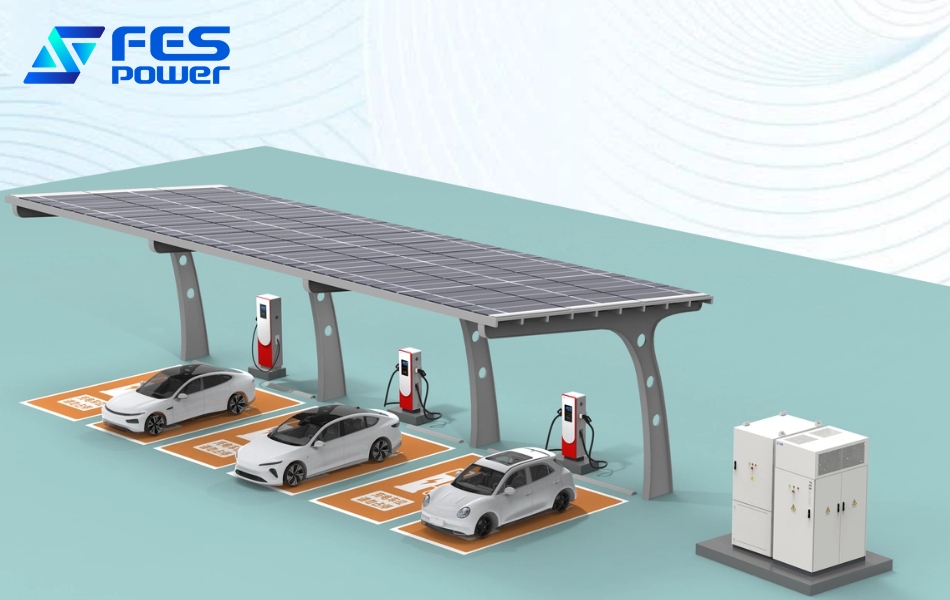
By integrating energy storage directly into charging infrastructure, Cannon300 helps operators reduce grid dependency, improve charging reliability, and optimize operational efficiency.
🌍 What Will The Next Generation Of Charging Stations Look Like?
The future charging station will no longer function as just a charger.
Instead, it will become:
⚡ An energy management center
🔋 A distributed storage node
☀️ A renewable energy integration platform
🤖 An AI-driven smart infrastructure system
As charging demand continues to rise, battery storage will no longer be optional.
It will become one of the core foundations of fast EV charging infrastructure.
🚀 Final Thoughts
The EV charging industry is entering a new era.
The competition is no longer only about charging speed.
Instead, the real focus is shifting toward:
🔋 Energy efficiency
⚡ Grid flexibility
🌍 Sustainable infrastructure
🤖 Intelligent energy management
And battery storage is becoming the key technology enabling this transformation.



 شبكة IPv6 مدعومة