
- اتصل بنا : +86-15060765919
- راسلنا : bella@fespower.cn
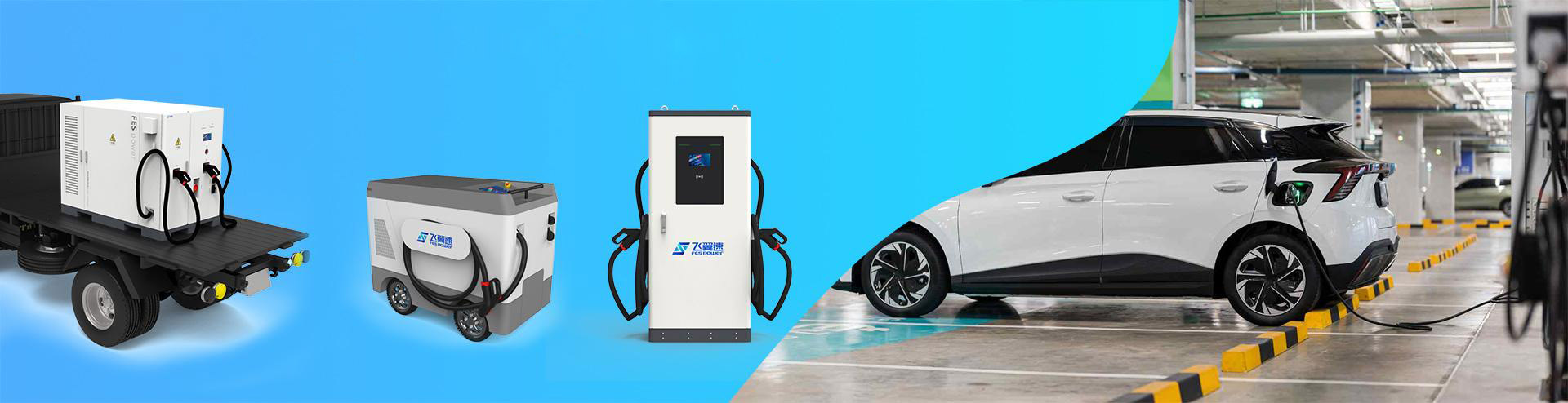
As EV adoption accelerates worldwide, charging infrastructure is evolving rapidly. Fast charging power continues to increase, while operators are expected to deliver higher efficiency, shorter charging times, and more flexible deployment. However, behind this growth lies a critical challenge: energy supply.
When EV charging meets Battery Energy Storage Systems (BESS), charging stations begin to change from simple charging points into integrated energy hubs.
Why Energy Storage Matters For EV Charging
Traditional charging stations rely heavily on the power grid. As charging demand rises and charging power moves toward ultra-fast DC charging, many sites face limitations such as insufficient grid capacity, high electricity costs, and expensive infrastructure upgrades.
Common challenges include:
⚡ High peak electricity charges
⚡ Grid capacity constraints
⚡ Expensive transformer upgrades
⚡ Difficult deployment in remote or commercial locations
⚡ Growing demand for high-power charging
These challenges become even more significant as the industry moves toward 600kW liquid-cooled charging and future megawatt charging applications.
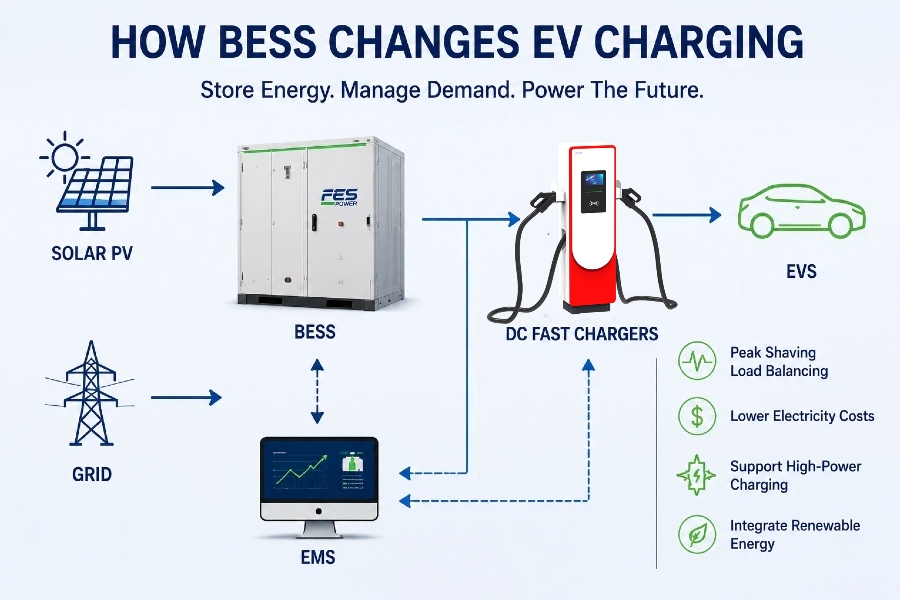
How BESS Changes EV Charging
By integrating energy storage with charging infrastructure, stations gain the ability to store electricity during low-demand periods and release it when charging demand increases.
This creates several advantages:
🔋 Peak Shaving And Load Balancing
Energy storage reduces peak demand pressure by supplying additional power during charging peaks, helping lower operating costs and improve grid stability.
⚡ Support High-Power Charging Deployment
Instead of depending entirely on grid expansion, charging stations can combine existing grid supply with stored energy to support fast charging applications.
☀ Integration With Renewable Energy
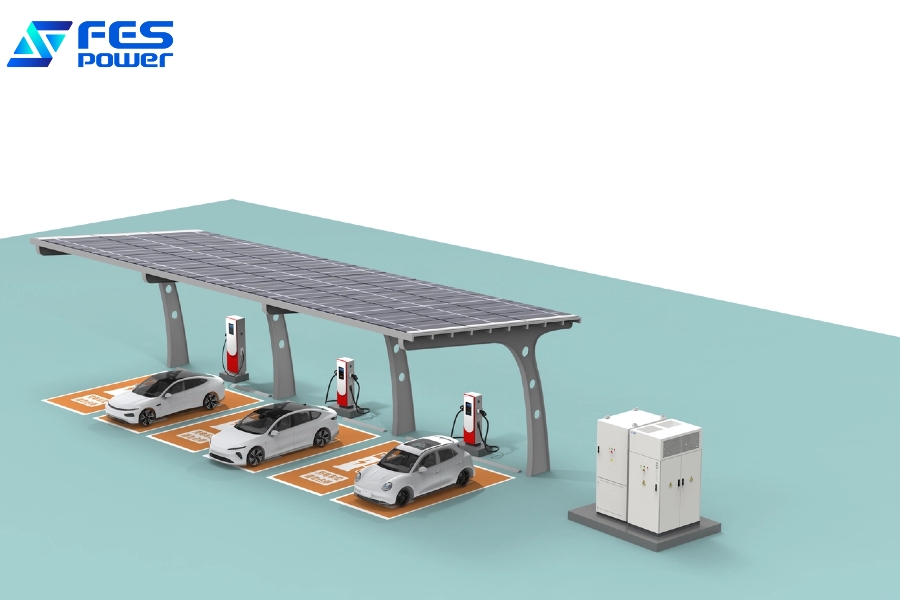
Battery storage also enables the combination of Solar + Storage + Charging, allowing solar energy to be stored and later used for EV charging.
As a result, charging stations are evolving into complete energy ecosystems that integrate power generation, storage, charging, and management.
FES Power Cannon300 Energy Storage Solution
To support next-generation charging projects, FES Power introduced the Cannon300 energy storage solution, designed for integrated energy and charging applications.
The Cannon300 provides stable energy support for commercial charging stations, fleet charging depots, and Solar + Storage + EV Charging projects.
Key features include:
🚀 Supports integrated charging and energy storage applications
🚀 Suitable for commercial charging scenarios and ultra-fast charging support
🚀 Compatible with Solar + Storage + Charging solutions
🚀 Flexible deployment for different project environments
🚀 Intelligent energy management to improve operational efficiency
With Cannon300, operators can optimize energy usage, reduce grid dependency, and improve charging station performance.
The Future Of EV Charging Is Energy Management
The future of EV charging is no longer only about increasing charging speed. The focus is shifting toward how energy is generated, stored, and managed.
Future stations will not simply deliver electricity — they will manage energy intelligently.
And as EV infrastructure continues to expand, integrated solutions combining EV charging + energy storage + smart energy management will become an essential part of the next generation of charging networks.



 شبكة IPv6 مدعومة